Are Real Estate Taxes the Same as Property Taxes?
March 16, 2026
March 16, 2026
If you’ve ever heard the terms real estate taxes and property taxes used like they mean the same thing, you’re not alone. Most homeowners, buyers, and sellers hear both phrases and assume they’re interchangeable.
In many cases, they are.
But there’s a small difference in how the terms are often used, and understanding that difference can help you make more sense of tax bills, escrow accounts, and homeownership costs.
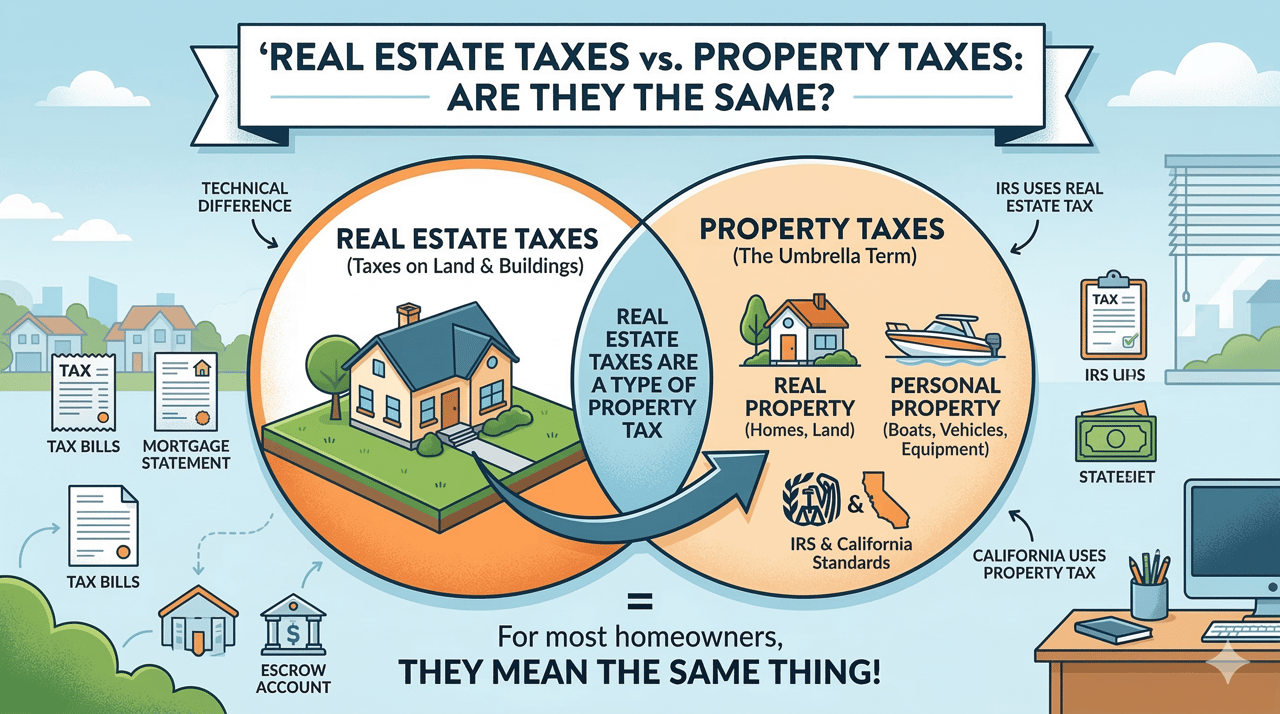
Real estate taxes are usually a type of property tax.
In everyday conversation, many people use the two terms interchangeably when talking about taxes paid on a home or land. The IRS also uses the term real estate taxes when referring to taxes on real property, while California property tax agencies generally use property tax as the broader standard term.
Real estate taxes are taxes charged by local governments on real property—meaning land and anything permanently attached to it, such as a house. The IRS defines deductible real property taxes as state or local taxes based on the value of the real property and levied for the general public welfare.
In simple terms, if you own a home, the tax bill you pay to your county is usually what people mean by real estate taxes.
Property taxes is the broader term. It can refer to taxes on real property like homes and land, and in some contexts it can also include personal property such as business equipment, boats, or manufactured property, depending on state and local rules. California county assessors, for example, commonly describe property tax systems as covering both real estate and personal property.
That means:
Real estate taxes = taxes on land and buildings
Property taxes = may mean the same thing in a homeownership context, but can also be a broader umbrella term
For most homeowners, yes, they usually mean the same thing.
If you’re reading a mortgage statement, looking at closing paperwork, or reviewing a county tax bill, the phrase real estate taxes is typically referring to the property taxes on your home. That’s why many lenders, tax professionals, and homeowners use the terms almost interchangeably.
The difference matters more when you’re being technical:
Real estate tax refers specifically to tax on real property
Property tax can sometimes include other taxable property beyond real estate
Understanding the language helps in a few practical ways.
Many homeowners pay property taxes through an escrow account. Your lender collects a portion each month and then pays the county when the bill comes due. Some lenders call these property taxes, while tax documents or IRS publications may call them real estate taxes.
The IRS says homeowners may be able to deduct state and local real estate taxes if they itemize, subject to applicable limits. The IRS also notes that not every charge on a property tax bill is deductible—for example, assessments for local improvements like sidewalks or sewer lines are treated differently.
Property taxes are one of the major ongoing costs of owning a home. In California, property tax bills are based on assessed value under state law, and additional voter-approved debt or special assessments may appear on the bill as well.
Let’s say you own a single-family home.
Your county sends you a yearly tax bill based on the assessed value of that home. A lender may call that amount property taxes in your monthly payment breakdown. A tax professional or IRS publication may refer to that same expense as real estate taxes. In that scenario, they are talking about the same basic tax on your home.
Now imagine a business owner paying tax on equipment in addition to land and a building. In that broader setting, property tax may include more than just real estate.
For California homeowners, property taxes are generally administered at the county level, with assessed values established according to state law. California’s property tax system is shaped heavily by Proposition 13, which limits the general property tax rate to 1% of assessed value, plus certain voter-approved indebtedness and other charges that may appear on the bill.
That’s one reason buyers and sellers in California should never assume a current tax bill will tell the full story after a sale. A property can be reassessed based on a change in ownership, which may affect future taxes.
Usually, yes. On a mortgage statement, those terms generally refer to the taxes owed on your home.
No. The IRS says certain charges for local benefits and improvements are not treated the same as deductible real property taxes.
Not always directly. In California, the assessed value used for taxation follows state rules and is not simply a live snapshot of current market value.
Are real estate taxes the same as property taxes?
For most homeowners, yes—practically speaking, they usually refer to the same tax on your home. But technically, property taxes can be a broader term, while real estate taxes refer specifically to taxes on real property like land and a house.
Knowing that distinction can make it easier to understand your mortgage, your closing documents, and your annual tax bill.
This article is for general informational purposes only and is not tax or legal advice. For advice on your specific situation, it’s best to speak with a tax professional or your local county tax office.
You’ve got questions and we can’t wait to answer them.