Why Some Riverside County Homes Sell Fast… While Others Sit for Weeks
March 12, 2026
March 12, 2026
If your home is on the market in Riverside County and not getting serious traction, the problem is usually not “bad luck.” More often, it comes down to pricing, presentation, condition, buyer fit, or how the home is being marketed. That matters even more now because Riverside County is not moving at one uniform speed. Depending on the data source, homes are taking about 39 days to go pending on Zillow and about 73 days to sell on Redfin, with Redfin also showing a year-over-year increase in days on market. Those are different metrics, but together they point to the same reality: buyers are active, yet they are more selective than many sellers expect.
The hard truth is that homes that sell quickly usually do not succeed because the market is easy. They succeed because they are positioned correctly from day one. Homes that sit for weeks are often overpriced, poorly prepared, weakly marketed, or simply mismatched to what today’s buyers are willing to pay for that location, condition, and risk profile. Riverside County’s median sale price was around $600,000 in February 2026, but Redfin also showed a 98.4% sale-to-list ratio, only 25.6% selling above list, and 24.1% with price drops. That is not a market where sellers can casually “test” an inflated price without consequences.
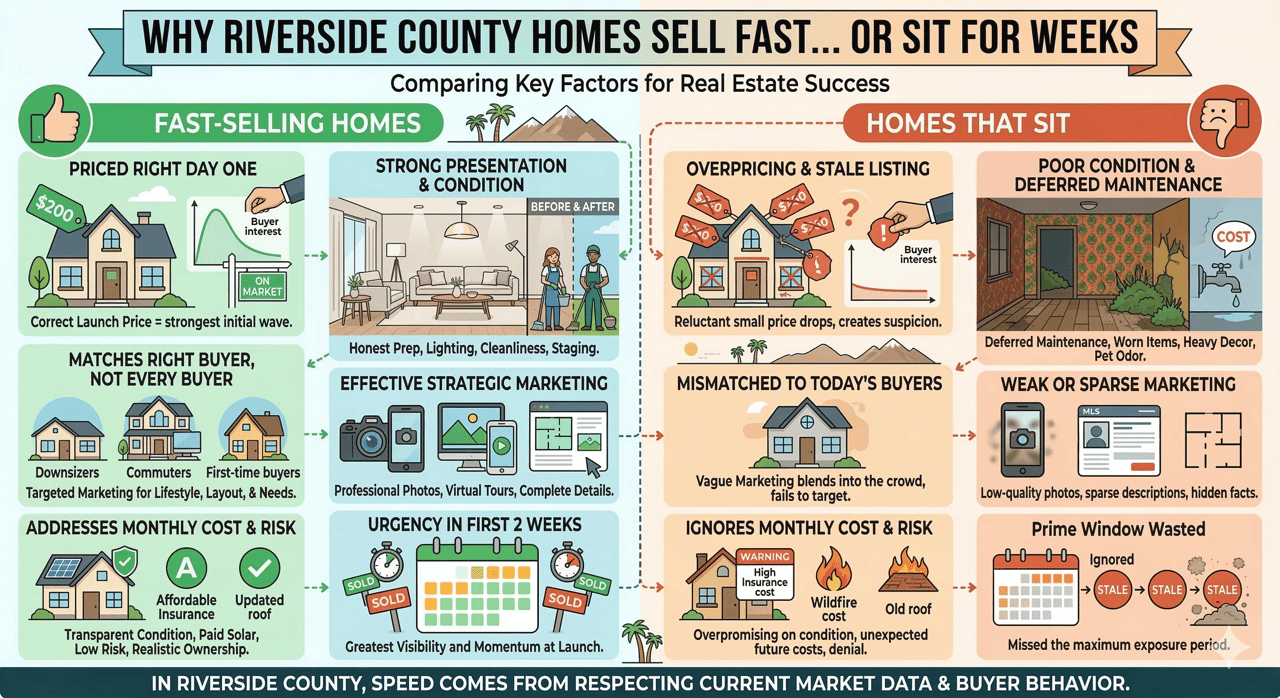
This is still the most common mistake, and sellers do not always realize they are making it. Many price based on what a neighbor got six months ago, what they “need” to net, or what an online estimate suggests on its best day. Buyers do not care about any of that. They compare your home against the homes they can see right now, in the same price band, with similar upgrades, schools, commute, and monthly payment. When a home is overpriced at launch, the first wave of buyer interest passes it by, and that first wave is usually the strongest.
This is where many sellers hurt themselves twice. First, they price too high. Then, after the home sits, they reduce the price in small, reluctant steps. By then, buyers often assume something is wrong. A stale listing rarely creates confidence. It creates suspicion. In a market where Zillow reported 53.2% of Riverside County sales closing under list price and a 0.993 median sale-to-list ratio, buyers are clearly willing to wait, compare, and negotiate.
Most homeowners live with their property long enough to stop noticing the things buyers notice instantly: worn flooring, dated lighting, heavy furniture, pet odor, deferred maintenance, overgrown landscaping, patched walls, or a kitchen that feels darker in person than it did in memory. Sellers often call these “small things.” Buyers call them “future expenses.” NAR’s 2025 home staging research found that 83% of buyers’ agents said staging made it easier for buyers to visualize a property as a future home, and 49% of sellers’ agents said staging reduced time on market.
That does not mean every Riverside County home needs expensive full-service staging. It does mean most homes need honest prep. Decluttering, lighter furniture placement, neutralizing bold decor, improving lighting, fixing obvious defects, and making the home photograph well are not cosmetic extras. They are part of the sales strategy. NAR also found that 73% of buyers’ agents said photos were highly important, along with strong use of videos and virtual tours. A home that looks average online will lose showings before a buyer ever reaches the front door.
Not every Riverside County home should be marketed the same way. A single-story home with a low-maintenance yard may appeal strongly to downsizers. A larger home near commuter routes may attract move-up buyers. A well-kept home in a price-sensitive segment may draw first-time buyers who are calculating every monthly cost. When sellers or agents use vague marketing, the listing blends into the crowd. When the home is clearly positioned for the buyer most likely to value it, the response is usually better. This is especially important in a county as varied as Riverside, where buyer priorities can shift significantly from one city or neighborhood to another.
The mistake is trying to appeal to everyone. A listing that says “beautiful home with great features” says almost nothing. Buyers click on specifics. They respond to lifestyle, layout, convenience, and practical value. If the home is ideal for downsizing, say so. If the backyard is easy to maintain, say so. If the home offers a main-floor bedroom, paid solar, remodeled baths, or a shorter commute corridor, highlight it clearly. The faster sale often goes to the listing that makes the buyer think, “This fits me.” That is not fluff. That is targeting.
A surprising number of listings still fail at the basics. Weak photography, sparse descriptions, poor room flow in the photo order, missing floor plan details, and little effort to explain upgrades or neighborhood benefits can quietly cost sellers thousands. Buyers shop online first. If the listing does not create urgency there, the home will not get enough strong showings in person. NAR’s 2025 staging release also noted that buyers’ agents place high importance on listing photos, videos, and virtual tours. That lines up with what sellers are seeing in real time: the online first impression now does much of the heavy lifting.
And there is a second issue: many listings do not tell the truth clearly enough. If a home backs to a busy street, has an older roof, or is in a higher-risk insurance area, buyers will find out. A smart listing does not hide the weaknesses. It manages them by pricing properly, improving what can be improved, and emphasizing the home’s best advantages honestly. Overpromising only increases disappointment at showings.
This is one of the most under-discussed reasons some homes linger. Buyers are not just evaluating price anymore. They are evaluating total ownership cost and future hassle. In Riverside County, risk factors can matter. Redfin’s county page, drawing on First Street data, shows 91% of properties have some wildfire risk over the next 30 years, and C.A.R. has a dedicated homeowners insurance resource hub addressing California’s wildfire-related insurance challenges. That does not make a home unsellable. It does mean buyers may scrutinize insurance availability, premiums, roof age, defensible space, and location more carefully than sellers expect.
This is where preparation beats denial. If a seller knows the roof is older, the HVAC is near the end of its life, or insurance has become harder to place, that should shape both the pricing and the conversation. Serious buyers can handle facts. What they dislike is surprise. Homes tend to sell faster when the numbers and the property condition make sense together. They sit when buyers feel the seller is asking premium money while handing off obvious future costs.
When a home first hits the market, it gets the greatest visibility with new-buyer alerts, saved searches, agent attention, and simple curiosity. If the home launches overpriced or underprepared, that prime window gets wasted. Later price reductions can help, but they rarely recreate the same momentum. This is one reason why homes that “eventually” find the right price often still sell for less than they might have if they had been positioned correctly from the beginning. Redfin’s February 2026 Riverside County data showed a rise in average days on market year over year, which makes a strong launch even more important.
A stale listing also changes the buyer’s mindset. Instead of competing for it, buyers start looking for leverage. They assume the seller may be flexible, frustrated, or covering up an issue. Once that shift happens, the seller is negotiating from a weaker position. That is why price corrections after several quiet weeks are often expensive, not strategic.
The homes that move quickly are rarely perfect. But they tend to get these basics right:
They are priced in line with current buyer behavior, not past seller hopes. They show clean, bright, and cared for. They photograph well. They are marketed to the most likely buyer. And they remove as much uncertainty as possible around condition, cost, and value. In the current Riverside County market, that is what creates speed. Not wishful pricing. Not vague marketing. Not waiting for the “right buyer” to overlook the obvious.
If a Riverside County home sells fast, it is usually because the seller respected the market. If it sits for weeks, it is often because the seller expected the market to respect their number, their timeline, or their emotional attachment. Buyers are not trying to be difficult. They are being careful. And in today’s market, careful buyers tend to reward homes that feel well-priced, well-prepared, and easy to say yes to.
You’ve got questions and we can’t wait to answer them.