Is Downsizing Actually Cheaper? 7 Costs Riverside Homeowners Often Forget
August 7, 2026
August 7, 2026
Yes, downsizing can be cheaper for Riverside homeowners, but only if the long-term savings outweigh the costs of selling, moving, and buying the next home. A smaller house does not automatically mean a lower total cost, especially once property taxes, HOA dues, repairs, closing costs, and moving expenses are added in.
For many longtime homeowners, downsizing still makes good financial sense. The important part is running the numbers before assuming that moving smaller will automatically mean spending less.
The real cost of downsizing is more than the price difference between your current home and your next one.
A better comparison looks at two things:
For example, selling a large home and buying a smaller one may reduce utilities, landscaping, repairs, and future maintenance. But those savings can be partly offset by HOA dues, higher property taxes, insurance, financing costs, or improvements needed in the new home.
If you are still early in the process, this guide to downsizing from a larger home in Riverside County is a helpful place to understand the overall move before getting into the numbers.
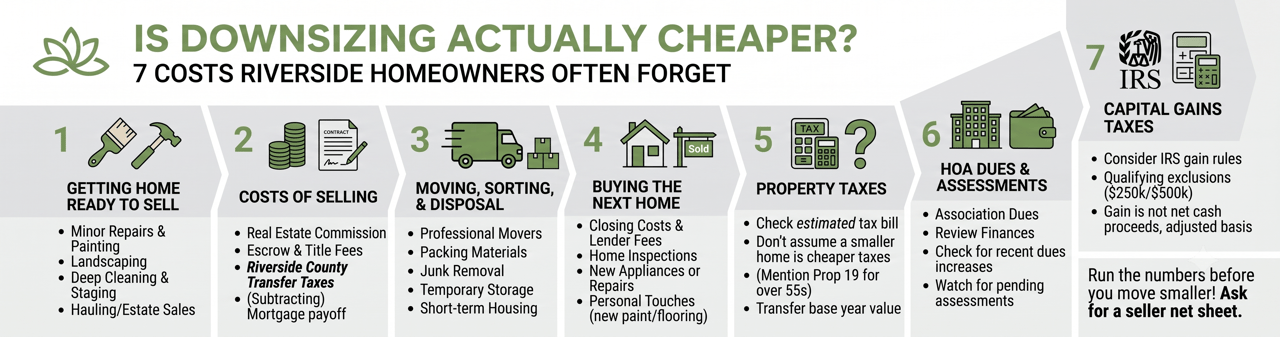
Here are seven costs homeowners often overlook.
A longtime home rarely goes directly from "we decided to move" to "ready for buyers."
There may be costs for:
You do not necessarily need to renovate the house before selling it. In some cases, spending too much on updates can reduce the financial benefit of downsizing.
The better question is which improvements are likely to help the home sell and which ones are unlikely to pay you back.
The sale price is not the same as the amount you will have available for your next move.
Your proceeds can be reduced by your mortgage or other liens, real estate compensation, escrow and title expenses, transfer taxes, agreed repairs, buyer credits, and other closing adjustments.
Riverside County also has a documentary transfer tax that can be part of a real estate transaction, depending on the circumstances.
This is why it helps to estimate your net proceeds, not simply look at what similar homes are selling for. Grove Realty's guide on how much you may net from selling a Riverside County home explains the difference.
A seller net sheet is especially useful for downsizers because it shows approximately how much money may actually be available for the replacement home after the sale closes.
Moving from a home you have lived in for 20 or 30 years can cost more than moving from a typical apartment or starter home.
There may be expenses for:
Sometimes the biggest challenge is not moving the furniture. It is deciding what to do with decades of belongings before the movers arrive.
Starting early can reduce rushed decisions and unnecessary storage costs. This Riverside County downsizing checklist can help organize the process before it becomes overwhelming.
Homeowners sometimes focus so much on what they will make from selling that they forget the purchase side of the move.
If you finance the replacement home, there can be lender fees and other mortgage-related closing costs. Buyers may also have expenses for inspections, escrow, title services, insurance, prepaid items, and other costs connected with closing.
The Consumer Financial Protection Bureau recommends reviewing the Loan Estimate carefully because the purchase price and mortgage payment do not represent the full amount needed at closing.
Even a cash purchase is not completely cost-free.
There is also the condition of the new home to consider. A smaller property may still need new flooring, paint, window coverings, appliances, accessibility improvements, or other work before it fits your needs.
That should be included in the downsizing budget.
This can be one of the biggest questions for longtime California homeowners.
Someone who has owned the same Riverside home for many years may have a taxable value far below today's market value. Selling that home and buying another property can affect property taxes.
For eligible California homeowners age 55 or older, Proposition 19 may allow the factored base year value of the original primary residence to transfer to a replacement primary residence anywhere in California. The replacement generally must be purchased or newly constructed within two years of the sale, and eligible homeowners can use the transfer up to three times.
That does not necessarily mean the new property tax bill will be identical to the old one. The value of the replacement property and other assessments can still affect what you pay.
Grove Realty has a more detailed explanation of transferring your property tax base when downsizing under Proposition 19.
Before choosing a replacement home, look at the estimated tax bill instead of assuming a smaller house will automatically carry lower property taxes.
Some homeowners downsize into condos, townhomes, gated neighborhoods, or 55+ communities because they want less exterior maintenance.
That convenience can be valuable, but it often comes with an HOA payment.
A community that handles landscaping, common areas, roofs, recreation facilities, gates, or other amenities may save you time and maintenance responsibility, but those costs are still being paid through association dues.
California buyers purchasing in a common-interest development generally become members of the homeowners association.
Before buying, look beyond the current monthly HOA amount. Review the association's finances, reserve information, insurance situation, recent increases, and any known or proposed special assessments.
A $450 monthly HOA, for example, adds $5,400 per year to the cost of owning the home.
That does not automatically make the community a bad choice. The HOA may be paying for services you currently pay for separately. The goal is to compare the total cost, not just the monthly dues.
If you are deciding between a regular neighborhood, a single-story home, and a 55+ community, Grove Realty's guide to where to downsize in Riverside can help you compare the lifestyle differences as well.
Longtime Riverside homeowners can sometimes have substantial appreciation in their homes.
Federal tax rules may allow qualifying homeowners to exclude up to $250,000 of gain from the sale of a primary residence, or up to $500,000 for certain married couples filing jointly. In general, ownership and use requirements apply.
One important distinction is that the exclusion applies to gain, not simply the amount of cash you receive at closing.
Your mortgage payoff affects your net proceeds, but it is not the same thing as calculating your taxable gain. The IRS generally looks at the amount realized from the sale compared with your adjusted tax basis, including qualifying adjustments and selling expenses.
For homeowners who bought decades ago, keeping records of major improvements can be particularly important.
A CPA or qualified tax professional should review your specific situation before you make a decision based on expected taxes.
Downsizing works best when you compare the entire financial picture.
Imagine selling a large Riverside home with a paid-off mortgage and buying a smaller property. At first glance, that sounds like an obvious way to save money.
But suppose the replacement property has:
The move could still be worthwhile, especially if your old home requires significant maintenance, landscaping, utilities, or future repairs. It simply may take longer for the savings to outweigh the upfront cost.
That is why the break-even point matters.
If downsizing costs $30,000 in total one-time expenses but saves you $750 per month afterward, it would take about 40 months for those monthly savings to recover the initial cost.
If you expect to stay in the next home for 10 or 15 years, that may be perfectly reasonable.
If you think you may move again in two years, the calculation looks very different.
A Riverside homeowner owns a large house with no mortgage. The yard, pool, utilities, and repairs are becoming expensive and tiring.
They sell and move into a smaller home in a 55+ community.
Their maintenance responsibilities drop significantly, but they now have an HOA payment. They may still come out ahead financially, especially if Proposition 19 helps with the property tax transition, but the HOA needs to be included when comparing monthly costs.
Another homeowner sells a two-story family home and buys a smaller single-story property nearby.
There is no HOA, and the new home uses less energy and has a smaller yard.
However, the replacement home needs a new HVAC system and bathroom updates.
In this case, downsizing could create meaningful long-term savings, but the buyer should keep part of the sale proceeds available for those immediate improvements rather than putting every dollar into the purchase.
A homeowner bought a Riverside property many years ago and now has significant equity.
Selling could release enough money to purchase the next home with little or no mortgage and leave additional funds available for retirement.
That can be a strong reason to downsize.
But before making the decision, the homeowner should calculate the seller's actual net proceeds, review possible capital gains exposure with a tax professional, estimate the cost of the next home, and compare the new annual housing expenses with the cost of staying put.
Downsizing is often cheaper over the long term when your current home has high maintenance costs, unused space, expensive utilities, a large yard, or major repairs coming in the next several years.
It may be less financially attractive if you are leaving a paid-off home to take on a large new mortgage, moving into a community with high HOA costs, buying a home that requires extensive improvements, or planning to move again fairly soon.
There is also more to the decision than money.
A smaller home may be easier to clean. A single-story floor plan may be more comfortable. Being closer to family, medical care, shopping, or friends may make everyday life easier.
Sometimes paying roughly the same amount for a home that fits your life better is still a successful downsizing move.
The key is not to ask, "Is the next house smaller?"
Ask, "Will the next home cost less to own and work better for the way I want to live?"
That gives you a much more useful answer.
Before you start packing or shopping for a smaller home, ask for a seller net sheet and compare it with the estimated monthly costs of two or three realistic replacement homes. Grove Realty can help you work through the local real estate numbers, and Marni Jimenez can help you compare your current home's likely proceeds with realistic downsizing options in Riverside County without assuming that moving smaller automatically means spending less.
You’ve got questions and we can’t wait to answer them.