What Are the Closing Costs for Sellers in Riverside, California?
August 17, 2026
August 17, 2026
Seller closing costs in Riverside, California, commonly include escrow and title fees, documentary transfer tax, recording or HOA charges, prorated property taxes, loan payoff-related fees, and any credits or real estate compensation agreed to in the contract. The exact amount depends on the home's sale price and the terms of the deal, so sellers should look at their estimated net proceeds, not just the final sale price.
Closing costs are the expenses that are paid or deducted when the sale is completed. Some are fairly predictable, while others depend on the property, the buyer's offer, and what the seller agrees to during negotiations.
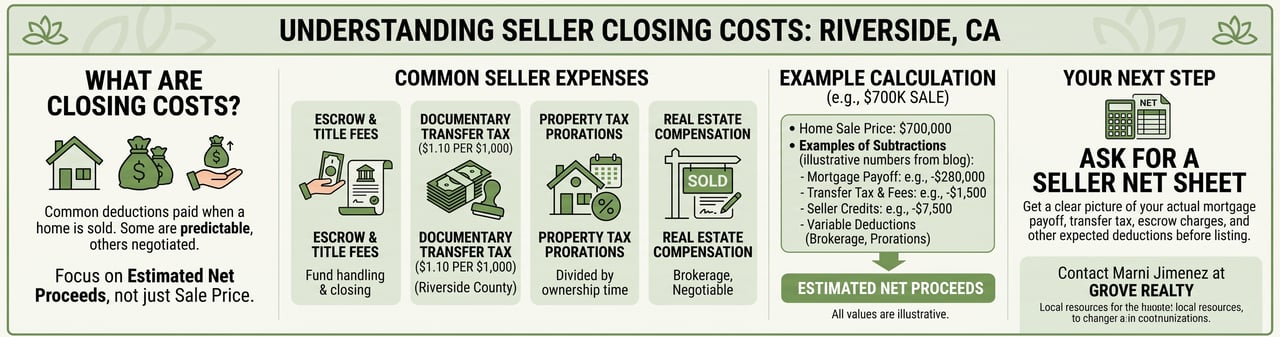
For a Riverside seller, common expenses can include:
For a broader picture of the expenses that can come with a sale, Grove Realty's guide to the cost of selling a house in Riverside explains how these costs fit into the overall selling budget.
The number that matters most to a seller is usually not the sale price. It is the amount left after the mortgage, closing expenses, negotiated credits, and other deductions are paid.
Imagine a home sells for $700,000. That does not mean the seller receives a $700,000 check.
The seller might still have a mortgage balance to pay off, escrow and title expenses, transfer tax, brokerage compensation, prorated taxes, and possibly a credit negotiated with the buyer.
Your mortgage payoff is technically different from a closing cost, but it has a major effect on the money you actually receive.
This is why it helps to estimate your home's realistic value before calculating your proceeds. Grove Realty's guide on what a Riverside County home may be worth gives sellers a useful starting point for understanding value before working through the expenses.
Here is a simple example using a $700,000 Riverside home.
Documentary transfer tax
Using Riverside County's rate of $0.55 for every $500 of taxable value, a straightforward $700,000 calculation would be about $770, assuming the full $700,000 is subject to the tax. The county ordinance provides for exclusions and exemptions in certain situations, so escrow should confirm the actual amount for the specific transaction.
Buyer credit
Suppose the buyer asks the seller for a $7,500 credit toward allowable closing expenses and the seller accepts. That $7,500 would reduce the seller's proceeds at closing.
Property taxes
If the seller has already paid property taxes covering a period beyond the closing date, the closing statement may include an adjustment. If taxes are still owed for the seller's ownership period, that can also be accounted for through escrow.
HOA property
A condo or planned-community home may have additional association-related expenses that a non-HOA property does not. Sellers should ask for the HOA fee schedule early rather than finding out about the charges shortly before closing.
Mortgage payoff
If the home sells for $700,000 and $280,000 remains on the mortgage, that balance must generally be paid through escrow before the seller receives the remaining proceeds. Any applicable lender payoff or reconveyance charges can also appear on the closing statement.
If you want to understand where these items appear during the transaction, Grove Realty's Riverside home-selling step-by-step guide walks through pricing, offers, disclosures, escrow, and closing.
There is no single percentage that accurately describes every Riverside seller's closing costs.
Two homes with the same selling price can produce very different net proceeds. One seller may have no HOA and receive an offer without a buyer credit. Another may agree to a sizable concession, have association charges, and need to resolve additional expenses during escrow.
Real estate compensation should also be discussed separately rather than assumed to be a fixed percentage. Compensation is negotiable, and current rules do not establish a standard rate that every seller must pay.
Repairs and home preparation are another consideration. Painting, landscaping, cleaning, staging, termite work, or repairs may reduce the seller's overall proceeds even when those expenses do not appear as traditional closing costs.
That is why it can be useful to review the full selling process before deciding which improvements are worth making. The Grove Realty Seller's Guide provides a local overview of preparing, listing, and moving through the sale.
A good estimate should ultimately answer one simple question: If my home sells for this amount, approximately how much money will I have left after everything is paid?
Ask for a seller net sheet based on your home's likely selling price. It can estimate the mortgage payoff, transfer tax, escrow and title charges, negotiated compensation, and other expected deductions before you commit to a listing price.
If you are selling in Riverside or elsewhere in Riverside County, Marni Jimenez can help you work through the numbers and understand what you may realistically net from the sale, and you can also explore local selling resources through Grove Realty.
You’ve got questions and we can’t wait to answer them.