How Do You Sell an Inherited House in Riverside County?
October 16, 2026
October 16, 2026
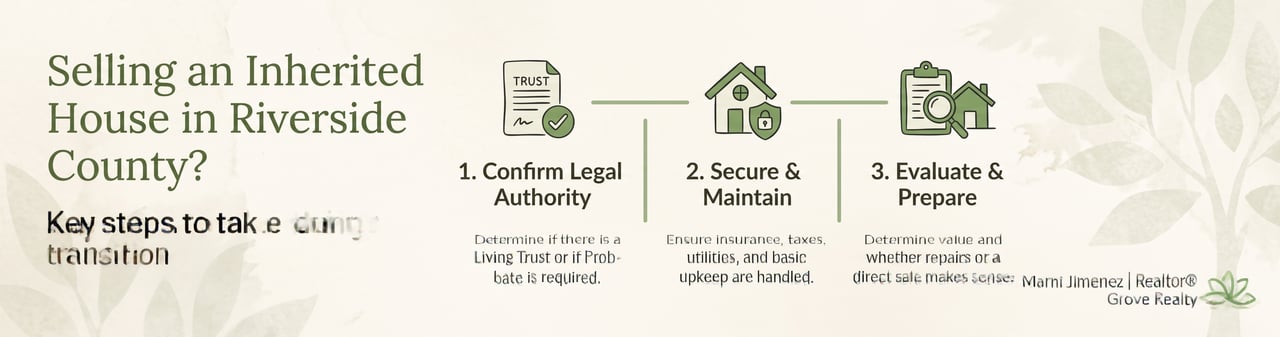
To sell an inherited house in Riverside County, start by finding out how the property is owned and who has the legal authority to sell it. If the home is held in a properly established trust, the process may be fairly straightforward, but if probate is required, there are additional legal steps to complete before the sale can move forward.
Inheriting a home often comes during a difficult time. Along with handling the loss of a loved one, you may be sorting through years of belongings, working with family members, and trying to figure out what to do with a property you weren't planning to own.
The good news is that you don't need to figure everything out at once.
Whether the home is in Riverside, Corona, Moreno Valley, Murrieta, or another Riverside County community, understanding a few important details can help you make thoughtful decisions and avoid unnecessary expenses.
One of the first questions I recommend answering is whether the property was placed in a living trust.
Many California homeowners establish living trusts so their property can pass to beneficiaries without going through the full probate process.
If the property is properly titled in the trust, the successor trustee may have the authority to sell the home without court supervision, depending on the trust's terms and circumstances.
The trustee will generally need to:
An important distinction: Having a living trust doesn't automatically mean the home is in the trust. The recorded deed and other estate documents need to be reviewed.
If you're unsure how the property is titled, an estate attorney or title professional can help determine the next steps.
Probate is the court-supervised process of settling someone's estate, paying applicable debts, and transferring property to the appropriate heirs or beneficiaries.
A will does not necessarily avoid probate.
If probate is required, the court generally appoints a personal representative, commonly called an executor or administrator, who is responsible for managing the estate.
That person may eventually have authority to sell the property.
Depending on the authority granted under California's Independent Administration of Estates Act, a probate sale may proceed without a separate court confirmation hearing, subject to required notices and other conditions.
In other situations, the sale may require court approval and potentially an overbid process.
This is why determining the legal status of the property before listing it is so important. A probate sale may involve a different timeline and contract considerations than a traditional home sale.
The Riverside County Superior Court's probate resources provide information about estate administration, local forms, and available procedures.
Here's an important California law change that families should know about.
For deaths occurring on or after April 1, 2025, certain primary residences valued at $750,000 or less may qualify for a simplified court procedure called a Petition to Determine Succession to Primary Residence.
This does not mean every inherited home under $750,000 automatically avoids probate. The home must have been the deceased person's primary residence in California, and specific legal requirements apply.
The petition generally cannot be filed until at least 40 days after death, and court involvement is still necessary.
The qualifying value and the date of death matter. A property inherited from someone who died before April 1, 2025, may be subject to different limits.
An experienced probate attorney can help determine whether this option is appropriate for your situation.
You can review the California Courts' explanation of simplified estate transfers.
It's common for family members to assume that because they are named in a will or are expected to inherit the property, they can immediately list and sell it.
Unfortunately, it's not always that simple.
Before signing listing agreements or accepting offers, confirm who has the authority to act on behalf of the trust, estate, or current property owners.
This can help prevent delays and disagreements later.
An inherited home can continue generating expenses even when nobody is living there.
Some immediate priorities include making sure:
A vacant property that isn't maintained can develop costly problems surprisingly quickly.
For heirs who live outside Riverside County, having dependable local help becomes especially valuable.
I've also shared some practical guidance in my article about selling a parent's home when you live out of the area.
Many people worry that selling an inherited house will result in a large capital gains tax bill.
Fortunately, inherited real estate generally receives an adjusted tax basis based on its fair market value at the deceased owner's date of death, sometimes referred to as a stepped-up basis.
For example, suppose a parent purchased a home decades ago for $150,000, and its fair market value when they passed away was $600,000.
If the property is later sold for $615,000, the potentially taxable gain may be substantially smaller than the difference between the original $150,000 purchase price and the selling price.
Actual tax calculations depend on the property's adjusted basis, selling expenses, ownership circumstances, and other factors.
The IRS explains how inherited property is treated for capital gains purposes.
California property taxes are a separate consideration. Under Proposition 19, inheriting a parent's home does not automatically allow an heir to keep the parent's existing property tax assessment. Qualifying parent-child exclusions generally require the property to be the parent's principal residence and become the qualifying child's principal residence, with additional filing and value requirements.
If you're considering keeping the home rather than selling it, review the California Board of Equalization's Proposition 19 guidelines and speak with the county assessor or a qualified tax advisor before making your decision.
Every family situation is different, but here are three examples of how an inherited property sale might unfold.
Three adult siblings inherit their parents' longtime Riverside home.
The property is properly titled in the family trust, and one sibling has been named successor trustee.
After reviewing the trust with an attorney and confirming the trustee's authority, the family decides to sell.
The house needs cleaning, some cosmetic improvements, and landscaping work, but it's otherwise in reasonable condition.
Rather than investing in an expensive remodel, the family focuses on preparing the home to show well.
This is where a local real estate professional can help evaluate which improvements are worthwhile.
My article on repairs and updates that matter most before listing explains how to prioritize improvements without overspending.
A family inherits a home that was solely in their father's name. There was no living trust.
Before selling, the family consults an estate attorney to determine whether formal probate or a simplified transfer procedure applies.
If formal probate is necessary, they must work through the court process to establish the personal representative's authority.
During that time, the family can begin gathering information about the property, evaluating its condition, and researching its potential market value.
Once the necessary authority and sale requirements are confirmed, the property can be marketed with a plan that accommodates the estate's legal timeline.
For a helpful overview of a traditional home sale, see my step-by-step guide to selling a home in Riverside.
Let's say an older home in Riverside County hasn't been updated in 30 years.
The kitchen is original, the carpet is worn, and the property needs substantial cleaning.
It's natural for the heirs to wonder whether they should renovate before selling.
But a full renovation is not always the best financial decision.
Sometimes selling the home in its current condition, with an appropriate price and honest disclosure of known issues, is the most practical choice.
Other times, modest improvements such as interior paint, flooring, cleaning, and yard maintenance can make a meaningful difference.
Before spending money, I recommend obtaining a realistic estimate of the property's current market value and comparing that with the potential value after improvements.
My guide to determining what a Riverside home is worth explains why recent comparable sales, condition, and neighborhood demand matter.
One of the biggest concerns families have is what to do with a house that hasn't been updated in years.
The answer depends on the home's condition, location, price range, and likely buyers.
In many cases, a thorough cleaning, decluttering, minor repairs, and professional presentation can go a long way.
At Grove Realty, I help sellers identify practical improvements and can coordinate with trusted local vendors when additional work is needed.
I also provide light staging when appropriate, using my own decorative staging inventory to enhance a property's presentation without bringing in furniture.
The goal is to make smart decisions with the family's time and money.
Selling an inherited property does not mean you can ignore known property issues.
Some qualifying probate and trustee sales are exempt from California's standard Transfer Disclosure Statement requirements. However, other disclosure obligations may still apply, and an exemption does not permit misrepresentation or concealment of known material defects.
The exact requirements depend on the type of sale and the seller's circumstances.
My article on documents needed when selling a Riverside County home offers a useful starting point, although estate sales may require additional paperwork.
When several family members are involved, it helps to establish clear expectations early.
One heir may prefer to sell quickly, while another may want to renovate or keep the property.
A realistic estimate of the home's value and likely net proceeds can help make those conversations more productive.
Remember that the selling price isn't necessarily the amount available for distribution.
Outstanding mortgages, liens, property expenses, closing costs, negotiated credits, applicable taxes, and estate obligations can affect the final amount.
You can learn more in my guide on estimating net proceeds from a Riverside County home sale.
An estate attorney and CPA can help clarify how the proceeds should be handled and distributed.
Selling an inherited home is sometimes more complicated than selling your own residence.
There may be several decision-makers, family members living in other states, legal requirements, and a home filled with decades of personal belongings.
If you're searching for the best Realtor in Riverside CA to help with an inherited property, look for someone who offers clear communication, extensive local experience, and a thoughtful plan for handling the preparation and sale.
A good agent should understand the difference between a traditional sale and one involving an estate, recognize when legal guidance is needed, and keep everyone informed throughout the process.
I've been helping Riverside County families buy and sell homes since 1990. Through my boutique brokerage, Grove Realty, my focus is on personalized service, practical advice, and helping clients navigate important real estate decisions with confidence.
You can learn more about my experience and approach to real estate.
If you've inherited a home in Riverside County and aren't sure where to begin, start by gathering the property's deed, any trust or estate documents, and information about the home's condition.
Once you understand who has authority to sell, the next step is developing a realistic plan for the property.
If you'd like help understanding its market value, whether improvements are worthwhile, or what a sale might look like, I'm happy to have a conversation.
At Grove Realty in Riverside, California, I help families navigate home sales with clear guidance, thoughtful preparation, and personal attention.
You don't need to have all the answers before reaching out. Sometimes a simple conversation is the best place to begin.
Marni Jimenez | Realtor® | Grove Realty
Serving Riverside and surrounding Riverside County communities since 1990.
This article is for general educational purposes and is not legal, tax, or financial advice. Estate laws, property tax rules, and individual circumstances vary. Consult a qualified California estate attorney and tax professional about your specific situation.
You’ve got questions and we can’t wait to answer them.