Inherited a House in Riverside County? What Should You Do Before You Sell, Keep, or Rent It?
July 13, 2026
July 13, 2026
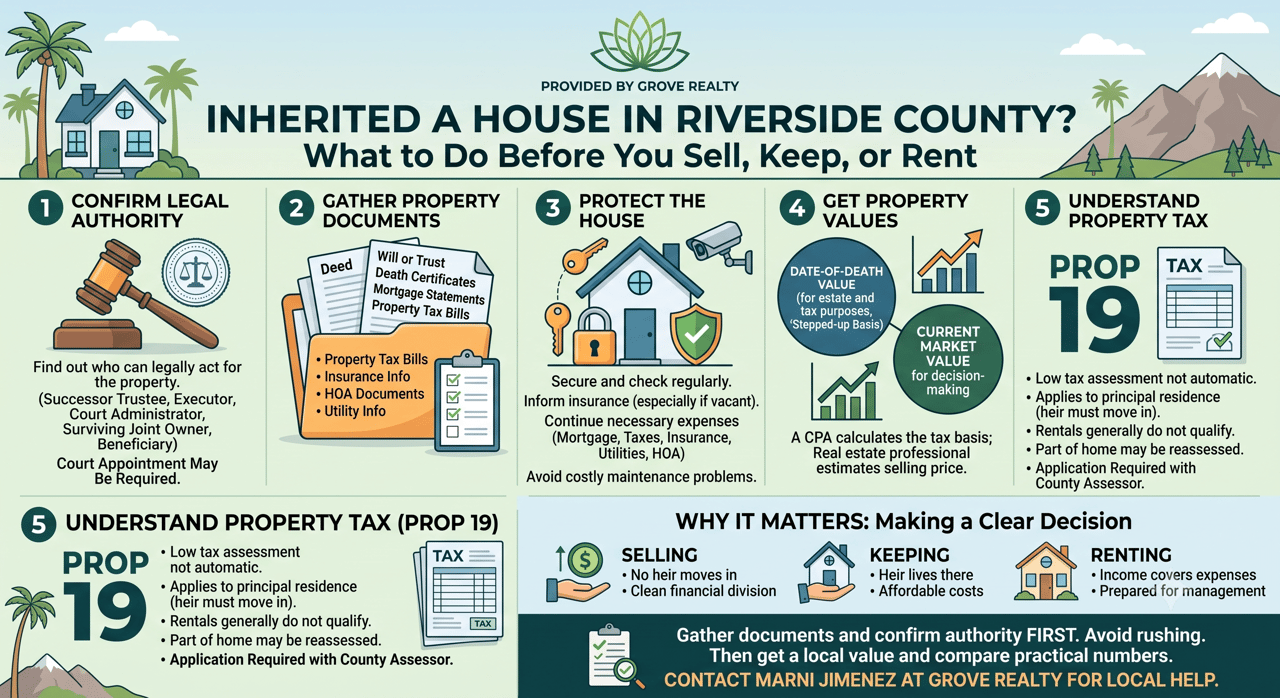
If you inherited a house in Riverside County, do not rush to sell it, rent it, renovate it, or move into it. First confirm who has legal authority to make decisions, how the property is titled, what the home is worth, and how probate and property tax rules may affect your options.
Inheriting a house can feel overwhelming, especially when you are also handling family responsibilities, personal belongings, bills, and paperwork. Breaking the process into a few clear steps can make it more manageable.
Start by finding out who can legally act for the property.
Being an heir does not always mean you can immediately list or sell the home. The person with authority may be:
California Courts explains that even when there is a will, an estate may still need to go through probate. When formal probate is required, the court appoints a personal representative to collect the assets, pay debts, manage the estate, and distribute what remains.
Before signing a listing agreement or accepting an offer, ask an estate attorney or title professional to confirm who has authority to sign.
Gather the important property documents.
Try to locate:
If the home belongs to a trust, review the trust documents with an attorney. If probate is needed, the Riverside County Superior Court has local probate resources and information about real property sales.
Protect the house while decisions are being made.
Keep the home secure and make sure someone checks it regularly. Confirm that the insurance company knows the owner has died and ask whether the existing coverage remains appropriate if the home is vacant.
Continue paying necessary expenses when estate funds and legal authority allow. These may include the mortgage, insurance, property taxes, HOA dues, landscaping, utilities, and basic maintenance.
Also forward the mail, remove food and trash, check for leaks, and protect important documents and valuables. A small maintenance problem can become expensive when a home sits unattended.
Families managing the property from another city or state may also find this guide on selling a parent’s home from out of the area helpful.
Get two types of property values.
An inherited home may need both:
The IRS states that the federal tax basis of inherited property is generally its fair market value on the date of death, or an alternate valuation date when properly elected. This is commonly called a stepped-up basis.
For example, suppose a parent bought a home decades ago for $120,000. The home was worth $600,000 when the parent died, and the heirs later sold it for $625,000. The potential taxable gain may be based more closely on the difference between the inherited basis and the selling price, not the original $120,000 purchase price. Selling expenses and other details can also affect the final calculation.
A CPA or tax professional should calculate the actual basis and taxable gain. A local real estate professional can separately help estimate the home’s current selling price. Grove Realty’s guide to determining a Riverside County home’s value explains what affects a local valuation.
Understand how Proposition 19 may affect the property taxes.
A parent’s low property tax assessment does not automatically transfer to a child.
Under Proposition 19, the parent-child exclusion generally applies only when the property was the parent’s principal residence and at least one eligible child makes it their own principal residence. The required exclusion claim and homeowners exemption must also be filed.
For transfers taking place from February 16, 2025, through February 15, 2027, the current exclusion calculation uses the property’s factored base-year value plus $1,044,586. If the home’s market value exceeds that amount, part of the property may be reassessed.
For example, an adult child who inherits a parent’s Riverside home and moves into it may qualify for some property tax protection. A child who keeps the home strictly as a rental generally will not qualify for the parent-child exclusion.
The Riverside County Assessor requires an application before it will consider the exclusion. Because deadlines and occupancy requirements matter, contact the Assessor and a qualified tax professional early.
The decision to sell, keep, or rent an inherited house affects more than the home itself. It can affect family relationships, property taxes, income taxes, monthly expenses, and how quickly an estate can be settled.
Selling may make sense when:
Selling does not always require a complete remodel. In many cases, cleaning, yard care, minor safety repairs, and thoughtful pricing are more practical than a major renovation. Before spending estate funds, review which repairs may be worth making before a sale.
Keeping the home may make sense when:
Do not base this decision only on the old property tax bill. Ask the Riverside County Assessor how the transfer may affect the taxable value.
Renting may make sense when:
Calculate the real monthly cost before choosing this option. Include the mortgage, reassessed property taxes, landlord insurance, HOA dues, repairs, vacancies, management fees, landscaping, and major future expenses.
A home that rents for $3,000 per month is not necessarily producing $3,000 in income. After expenses and periods without a tenant, the actual return may be much smaller.
One sibling wants the house and the others want cash.
Three siblings inherit a Riverside home. One wants to live there, while the other two would prefer to receive their shares.
A neutral valuation can help the family calculate a possible buyout. The sibling keeping the home will also need to consider financing, title transfer requirements, property taxes, and whether Proposition 19 applies.
The family should document the agreement with help from an attorney rather than relying on a verbal understanding.
The heirs live outside California.
A family inherits a home in Riverside County but lives in other states. The house needs cleaning, yard work, repairs, and regular checks.
A local real estate professional can help evaluate the home, recommend vendors, arrange access, monitor preparation, and communicate with escrow. Many documents can be handled electronically, although the estate’s attorney and title company should confirm the signing requirements.
This is an area where Marni Jimenez can provide practical local help without pushing the family into a decision before the legal and financial details are clear. Grove Realty serves buyers and sellers throughout Riverside County and regularly helps with relocation and major life transitions.
The home needs significant work.
An older home may have worn flooring, an outdated kitchen, deferred landscaping, or larger repair concerns.
Before renovating, compare three possible outcomes:
Ask for an estimated sale price and seller net for each option. A $40,000 renovation is not helpful if it increases the likely net proceeds by only $20,000.
Also include selling expenses in the calculation. Grove Realty’s guide to the cost of selling a Riverside home can help families identify common expenses.
The home must go through formal probate.
Formal probate does not necessarily prevent a future sale, but it can affect the timing, required notices, signing authority, and whether court involvement is needed.
California Courts says formal probate commonly takes 9 to 18 months and can take longer. The estate representative may need to inventory the assets, obtain an appraisal, address creditor claims, prepare tax returns, and report to the court.
Families should speak with their probate attorney before preparing the property for market or making promises to a buyer.
Probate rules, property tax rules, and income tax rules are separate.
A home can avoid formal probate because it was held in a trust and still be reviewed for property tax reassessment. A child may qualify for a Proposition 19 exclusion and still need tax advice about basis or a later sale.
It is also important to keep good records. Save receipts for repairs, cleaning, insurance, taxes, utilities, appraisal costs, legal expenses, and other money spent on the property. Keep notes showing which heir paid each expense and whether reimbursement is expected.
When several family members are involved, choose one person to be the main contact. That person can gather questions, share updates, and reduce conflicting instructions. Major decisions should still be approved according to the trust, probate orders, ownership documents, and family agreements.
Be careful about distributing furniture, tools, jewelry, records, or other belongings too quickly. Some items may belong to the estate, be specifically addressed in the will or trust, or be needed for valuation.
Finally, remember that a real estate agent can help with value, preparation, marketing, offers, and the sale itself. Questions involving authority, probate, trust administration, taxes, or disagreements between heirs should be handled by the appropriate attorney, CPA, tax advisor, or county office.
Gather the deed, trust or will, recent tax bill, mortgage statement, and insurance information, then confirm who has authority to act before spending money or making a decision about the home. Once that is clear, Grove Realty can help you get a local value and compare the practical numbers for selling, keeping, or renting.
You’ve got questions and we can’t wait to answer them.