Are Real Estate Taxes Tax Deductible?
August 3, 2026
August 3, 2026
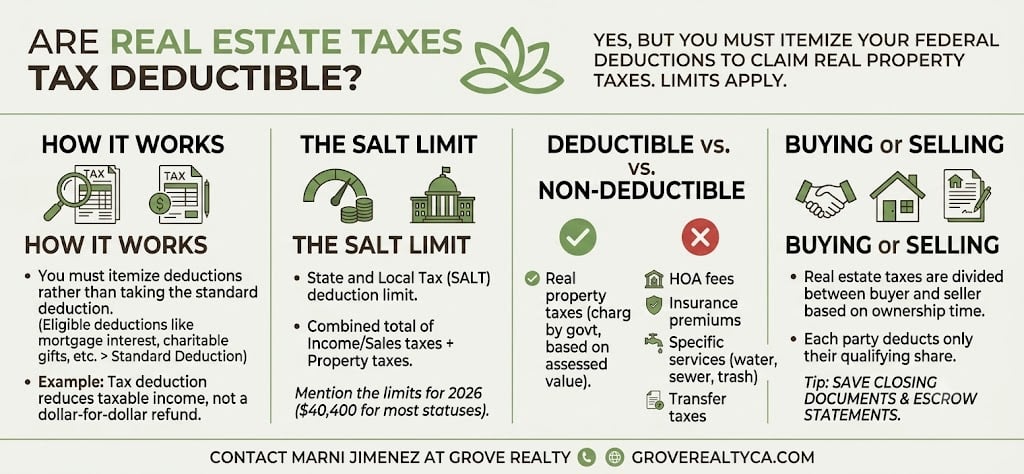
Yes, real estate taxes may be tax deductible when you itemize your federal deductions, but the amount you can claim depends on the type of charge, your filing situation, and the current state and local tax deduction limit.
For many homeowners, real estate taxes are one of the largest ongoing costs of owning a home. Understanding which charges may qualify for a deduction can help you keep better records and prepare more confidently for tax season.
However, not every amount shown on a property tax bill is automatically deductible. Federal and California rules may also treat certain expenses differently.
Real estate taxes—often called property taxes—are taxes assessed by a state or local government on land and permanently attached structures, such as a house.
For federal tax purposes, deductible real property taxes generally must be:
Homeowners who want a clearer explanation of the terminology can read Marni Jimenez’s guide to real estate taxes and property taxes.
The IRS generally allows qualifying state and local real property taxes to be included as an itemized deduction on Schedule A of Form 1040.
Real estate taxes on a primary residence or qualifying second home may be deductible when the homeowner itemizes deductions instead of taking the standard deduction.
Itemizing normally makes sense only when the total of your eligible deductions—such as property taxes, state income or sales taxes, qualified mortgage interest, charitable contributions, and certain medical expenses—is greater than the standard deduction available for your filing status.
A tax deduction reduces taxable income. It does not provide a dollar-for-dollar refund of the property taxes you paid.
For example, suppose a Riverside homeowner pays $7,500 in qualifying real estate taxes and $9,000 in California income taxes. Those amounts may be combined with other qualifying itemized deductions, subject to the federal state and local tax limit.
Real estate taxes are included in the state and local tax deduction, commonly known as the SALT deduction.
For the 2026 tax year, the federal deduction for qualifying state and local income, sales, and property taxes is generally limited to a combined total of:
The limit begins to decrease when modified adjusted gross income exceeds $505,000, or $252,500 for married taxpayers filing separately. The deduction will not be reduced below $10,000, or $5,000 for married taxpayers filing separately.
Because the SALT limit applies to the combined total, a homeowner cannot calculate the property tax deduction without also considering qualifying state income or sales taxes and personal property taxes.
Tax laws and income thresholds can change, so homeowners should confirm the rules for the specific tax year they are filing.
Not everything included in a mortgage payment, closing statement, or property tax bill qualifies as a real estate tax deduction.
Charges that generally cannot be claimed as personal real estate tax deductions include:
An assessment used to install a new sidewalk, sewer line, or similar improvement may not qualify as a deductible property tax. However, a portion used for maintenance, repairs, or interest related to an existing public improvement may receive different treatment.
Review the individual line items on the tax bill instead of assuming the full amount is deductible.
A Riverside County property tax bill may include more than the basic tax assessed against the home. Depending on the property and neighborhood, it may also include special assessments, voter-approved charges, or Community Facilities District taxes commonly called Mello-Roos.
The presence of a charge on the property tax bill does not necessarily mean the entire charge qualifies for a federal deduction. Deductibility can depend on how the charge is calculated and what the collected money is used for.
Homeowners considering downsizing or moving within California may also benefit from Marni Jimenez’s Riverside County Proposition 19 guide, which explains how an eligible homeowner may be able to transfer a taxable value to a replacement residence.
Proposition 19 affects how certain California properties are assessed. It is separate from the federal income tax deduction for property taxes.
Federal and California itemized deduction rules are not always identical.
California taxpayers generally use Schedule CA to adjust their federal itemized deductions according to California law. California does not conform to every federal deduction rule and does not follow the federal SALT limitation in the same way.
This means a homeowner’s allowable property tax deduction could be different on the federal and California returns.
A qualified California tax professional can compare both calculations and determine which expenses qualify under each system.
When a home is sold, real estate taxes are generally divided between the buyer and seller according to the portion of the property tax year each person owned the home.
Closing documents may show property tax prorations or reimbursements between the parties. Each party may generally deduct only the qualifying share treated as their responsibility under federal tax rules.
Buyers should save:
For more guidance on preparing for a Riverside purchase, review Marni Jimenez’s home buyer’s guide.
Sellers should also keep their closing documents. Although transfer and stamp taxes are generally not deductible as personal property taxes, certain selling costs may affect the calculation of the home’s adjusted basis or net proceeds.
Homeowners preparing to list can review Marni Jimenez’s home-selling guidance for Riverside homeowners.
Many homeowners pay property taxes as part of their monthly mortgage payment. The lender holds the funds in an escrow account and pays the taxing authority when the bill becomes due.
The amount deposited into escrow is not necessarily the amount deductible for that year. Generally, homeowners should use the amount the lender actually paid to the taxing authority during the tax year.
The annual mortgage or escrow statement can help identify the amount paid, but it should still be compared with the property tax bill and other records.
Real estate taxes paid on a rental property are generally handled differently from taxes on a personal residence.
Qualifying rental property taxes are typically reported as an expense against rental income on Schedule E rather than as a personal itemized deduction on Schedule A. Other rental expenses may also qualify, although passive activity, personal-use, and at-risk limitations may apply.
Owners who use a property partly as a residence and partly as a rental may need to divide expenses between personal and rental use.
Before claiming a real estate tax deduction:
Good records are especially important when a property was purchased, sold, inherited, converted to a rental, or used partly for business.
Real estate taxes can be tax deductible, but only qualifying taxes are included, and homeowners generally must itemize to receive the federal benefit.
The deduction may also be affected by the SALT limit, income-based reductions, property tax prorations, special assessments, rental use, and differences between federal and California tax law.
A tax professional should provide advice about deductions and tax filings. For help understanding how property taxes, estimated proceeds, or local housing costs could affect a real estate decision, contact Marni Jimenez at Grove Realty.
Marni Jimenez can help Riverside and Riverside County homeowners evaluate the real estate side of buying, selling, downsizing, or relocating so they can make their next move with greater confidence.
This article is provided for general educational purposes and is not legal, financial, accounting, or tax advice.
You’ve got questions and we can’t wait to answer them.