Do I Need a Local Realtor to Sell My Home?
August 26, 2026
August 26, 2026
No, you do not have to use a local Realtor to sell your home, but working with someone who knows your area can make pricing, preparing, marketing, and negotiating the sale much easier. For homeowners selling in Riverside County, especially downsizers or people who have owned their home for many years, a local real estate agent can also help you plan the sale around what comes next.
Selling a home involves much more than putting it online and waiting for an offer.
Your asking price needs to make sense for your specific neighborhood, property type, condition, lot, upgrades, and current competition. Two homes a few miles apart can attract different buyers or sell differently because of school boundaries, lot sizes, HOA rules, commute patterns, home styles, or simply what buyers are looking for in that part of town.
A local Realtor should understand those differences.
That becomes especially important when deciding which recent sales are actually useful comparisons. A home that looks similar online may not be a good comparable if it backs to a busy road, has a different floor plan, sits on a larger lot, or was extensively remodeled.
Before setting a price, it helps to understand what your Riverside County home may be worth in the current market. A local review can add context that an automated home value estimate may miss.
Local knowledge can help with other parts of the transaction too. California residential sales involve seller disclosures, and real estate agents have certain inspection and disclosure responsibilities when representing clients in covered residential transactions.
A Realtor who regularly works in your area should also be familiar with the normal process, common property concerns, local service providers, showing expectations, and the questions buyers tend to ask.
The goal is not simply to hire the Realtor who lives closest to your house. The goal is to find someone who understands your local market and knows how to turn that knowledge into a good selling strategy.
That can affect several important decisions.
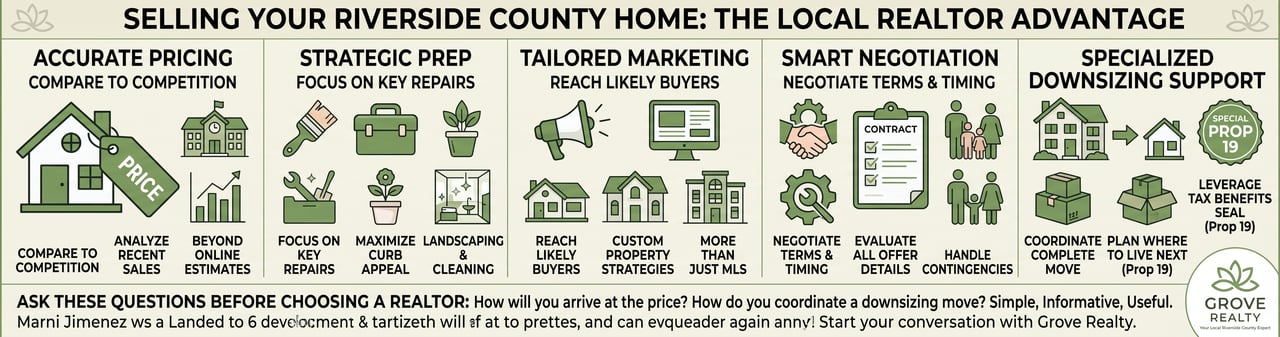
Pricing. A local agent can compare your home with recent sales and current competition, then look beyond the numbers to understand why certain homes sold quickly while others did not.
Preparation. Not every house needs a major renovation before it goes on the market. A knowledgeable agent can help you decide which repairs, cleaning, landscaping, staging, or updates are likely to matter to buyers and which expenses may not be worthwhile.
Marketing. Selling a Riverside home should involve more than placing it in the MLS. The marketing should make sense for the property and the likely buyer. A single-story home, a large family home, a condo, and a property on acreage may each need a different approach.
Negotiation. The highest offer is not always the strongest offer. Financing, contingencies, requested credits, inspection terms, timing, and the buyer's ability to close all matter.
Grove Realty's home-selling process explains how pricing, preparation, marketing, negotiation, and closing fit together.
For downsizers, local experience can be even more useful because selling is only half of the decision. You may also be thinking about where you will live next, how much money you will have after the sale, whether you should buy before or after selling, and how to make the move manageable.
If you are 55 or older, California's Proposition 19 may also be worth discussing with your tax adviser or county assessor. Eligible homeowners can transfer the taxable value of a primary residence to a replacement primary residence anywhere in California, up to three times, if the requirements are met. The replacement home generally must be purchased or newly constructed within two years of selling the original home.
That is one reason downsizing should be planned as a complete move rather than treating the home sale as a separate event.
Here are a few situations where having a Realtor with strong local knowledge can be particularly helpful:
These examples also show why "local" should mean more than knowing street names. You want someone who understands how homes are priced and sold in the area and can explain the reasoning behind their recommendations.
A local Realtor is not automatically a good Realtor.
Experience, communication, judgment, marketing, negotiation skills, and knowledge of your particular type of sale still matter. Someone can work in Riverside County every day and still be the wrong fit for you.
Before choosing a listing agent, ask how they arrived at the recommended price. Ask which homes they consider your strongest comparable sales and why. Find out what they would change or prepare before listing, how they plan to market the property, and how they will communicate once the home is on the market.
If you are downsizing, ask another question: How will you help me coordinate the sale with my next move?
That answer matters.
A downsizer may need time to sort decades of belongings, coordinate family members, arrange donations or movers, find a smaller home, or simply avoid feeling rushed. A good selling plan should take those needs into account.
It is also helpful to know your estimated net proceeds before making major decisions. Sale price is only one part of the picture. Mortgage balances, closing expenses, negotiated credits, repairs, and other costs can affect how much money is available for your next home.
If you are selling in Riverside or elsewhere in Riverside County, Marni Jimenez can help you look at the property, local comparable sales, timing, and your next-step plans before you decide how to move forward. This can be especially helpful for downsizers and long-time homeowners who want to understand their options before committing to a sale.
The right local Realtor should not pressure you into listing. They should help you understand what your home could realistically sell for, what preparation makes sense, what the process will look like, and whether selling supports what you want to do next.
Before choosing a Realtor, ask for a local home value and selling review that explains the comparable sales, recommended price range, preparation plan, estimated proceeds, and likely timeline. If you are selling or downsizing in Riverside County, you can start that conversation with Grove Realty.
You’ve got questions and we can’t wait to answer them.