Should You Downsize or Age in Place? A Riverside County Homeowner’s Guide
July 20, 2026
July 20, 2026
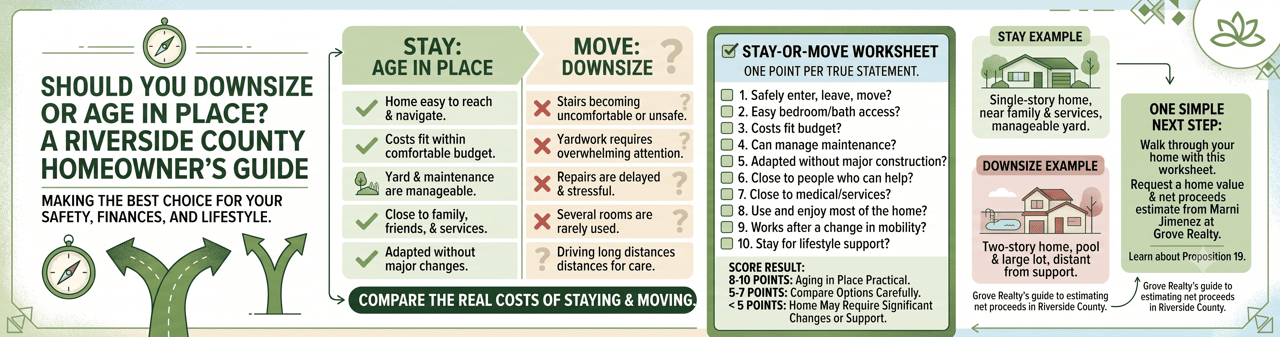
Age in place if your current home is safe, affordable, manageable, and close to the people and services you rely on. Consider downsizing if stairs, yardwork, repairs, rising costs, or distance from support are making daily life harder or may limit your independence later.
There is no single right answer. The best choice is the one that supports your finances, safety, relationships, and the way you want to live over the next several years.
Staying may make sense when your home continues to fit your daily life.
Good signs include:
A paid-off home is not automatically an inexpensive home. Still, remaining in a familiar house can be a good decision when the ongoing costs are predictable and the home can be maintained without creating stress.
AARP found that 75 percent of adults age 50 and older would like to remain in their current home as long as possible. At the same time, 44 percent believe they may eventually need to move. That difference shows why it helps to plan before a decision becomes urgent.
A home can be full of good memories and still stop working well for the person living in it.
It may be time to seriously compare your options when:
One difficult weekend of yardwork does not necessarily mean you should move. A pattern of postponed repairs, unused space, physical strain, and growing expenses deserves a closer look.
Downsizing also does not have to mean leaving Riverside County. It could mean moving into a single-story home, a smaller property, or a lower-maintenance community near the people and places you already know.
This Riverside County downsizing guide explains how to begin thinking through the transition without immediately committing to a sale.
Many homeowners compare only their current mortgage payment with the price of another home. That leaves out several important expenses.
When estimating the cost of staying, include:
When estimating the cost of moving, include:
A smaller home is not always less expensive. A newer condominium with HOA dues, higher insurance, and a new property tax assessment could have a higher monthly cost than expected.
The opposite can also be true. Selling a larger home with significant equity and buying a more manageable property may reduce maintenance, free up cash, and make retirement expenses more predictable.
Before deciding, ask for a realistic estimate of both your home’s selling price and your likely net proceeds. They are not the same number. Grove Realty’s guide to estimating net proceeds from a Riverside County home sale explains the expenses that may be deducted at closing.
Safety is not only about your health today. It is also about whether your home would continue to work after a temporary injury or change in mobility.
Walk through the property and look at:
The National Institute on Aging recommends practical improvements such as better lighting, secured flooring, bathroom grab bars, handrails, lever-style handles, and safer entrances. These changes can make aging in place more realistic without requiring a major remodel.
Some homes can be adapted fairly easily. Others would require major changes to entrances, bathrooms, bedrooms, or stairways. In that situation, moving to a home with a better layout may be simpler than trying to redesign the current property.
A home does not have to be falling apart to become burdensome.
Think about what the property will require during the next five to ten years. A roof, HVAC system, exterior paint, pool equipment, plumbing, windows, or landscaping may need attention even if everything is working today.
Ask yourself:
Planning ahead gives you more choices. Waiting until the home becomes physically or financially difficult can lead to a rushed sale or a move made during a stressful time.
A move should make life easier, not leave you isolated.
Consider how each option affects your connection to:
A smaller home farther from everyone you know may not improve your quality of life. A smaller home in the same part of Riverside County could provide less maintenance while preserving familiar relationships and routines.
The Riverside County Office on Aging offers information, options counseling, transportation assistance, care coordination, caregiver support, nutrition services, and other programs for qualifying residents. Homeowners who want to understand available support can contact its HelpLink line at 877-932-4100.
Many longtime Riverside County homeowners have built substantial equity. That equity may provide more options than expected, but it is important to calculate the amount that would actually remain after the sale.
Start with:
Do not assume that all your equity should go into the next property. Some homeowners prefer to buy a less expensive home and keep part of the proceeds available for retirement, medical needs, travel, or family goals.
Others decide that staying is financially stronger after comparing the numbers. The purpose of the calculation is not to justify moving. It is to understand your choices.
California homeowners who are at least 55 when they sell their original primary residence may qualify to transfer its factored base year value to another primary residence anywhere in California.
The replacement home generally must be purchased or newly constructed within two years before or after the sale. Eligible homeowners may use the benefit up to three times.
Proposition 19 transfers the taxable value used to calculate property taxes, not the exact tax bill. A replacement property can cost more than the home being sold, but part of the price difference may be added to the transferred taxable value.
Claims are not handled automatically through escrow. After both transactions are complete and the homeowner is living in the replacement residence, the appropriate claim must be filed with the assessor in the county where the new home is located.
Because individual circumstances vary, confirm the details with the county assessor and a qualified tax professional. Grove Realty’s Proposition 19 guide for Riverside County homeowners provides a helpful overview of the general requirements.
Consider a homeowner living in a paid-off, single-story Riverside home.
The property has a small, manageable yard. The bedroom, bathroom, laundry, and kitchen are all on the same level. Family members live nearby, and the homeowner is close to doctors, friends, shopping, and church.
The home may need better lighting, bathroom grab bars, and a few updated door handles. Those are manageable changes compared with the cost and disruption of selling and moving.
In this situation, aging in place may offer the best combination of comfort, affordability, support, and independence.
Now consider a homeowner living alone in a two-story house with four bedrooms, a pool, and a large yard.
Most of the upstairs rooms are rarely used. The homeowner is paying for pool service, landscaping, higher utilities, and frequent repairs. Adult children live across town, and medical appointments require long drives.
A single-story home with a smaller yard near family could reduce physical work and make daily routines easier. After estimating the current home’s value and net proceeds, the homeowner may also discover that the move could free up money for savings.
In this situation, downsizing may be less about owning a smaller house and more about creating an easier life.
The decision is not always limited to staying in the same home or moving far away.
A homeowner might sell a large Canyon Crest property and purchase a smaller single-story home nearby. Another might move from a large lot in Riverside to a lower-maintenance community in Corona, Hemet, Murrieta, or another part of the county.
Someone who wants community activities and exterior maintenance may consider a 55-and-over community. Someone who prefers fewer restrictions may choose a regular neighborhood with single-story homes.
Grove Realty’s guide to places to downsize in Riverside covers several neighborhood and housing options, including the practical details to review before choosing a community.
Grove Realty has helped real Riverside County homeowners approach downsizing by creating one clear plan for the home sale, sorting, timing, and the next living situation.
In a published local downsizing case study, the process began by answering three questions:
Starting with those questions helped keep the homeowners from feeling rushed or trying to handle every decision at once. It also allowed the real estate plan to support the homeowners’ life goals instead of allowing the sale to control the entire process.
Give yourself one point for every statement that is currently true.
A score of eight to ten suggests aging in place may remain practical.
A score of five to seven means it may be worth comparing both options carefully.
A score below five does not mean you must sell. It does suggest that the home may require significant changes, support, or expense to remain a good long-term fit.
This worksheet is only a conversation starter. Health, family responsibilities, finances, and personal preferences may carry more weight than the score.
A smaller home is not automatically easier.
Pay attention to:
A well-designed 1,800-square-foot single-story home may be easier to manage than a poorly designed 1,300-square-foot home with stairs and limited storage.
Focus on how the home functions, not simply how large it is.
Leaving a longtime home can feel like leaving part of your family’s history.
You may be sorting through children’s belongings, inherited furniture, photographs, holiday decorations, and items connected to important memories. That part of downsizing often takes longer than expected.
Start with areas that carry less emotion, such as the garage, linen closet, kitchen duplicates, or unused guest rooms. Work in short sessions and use simple categories such as keep, give to family, donate, sell, and discard.
You do not need to make every decision in one weekend.
A real estate professional can estimate your home’s value, likely selling expenses, and possible net proceeds. A tax professional can explain income tax questions, and the county assessor can confirm how Proposition 19 may apply.
An occupational therapist or aging-in-place specialist can help evaluate whether the current home can be modified safely. Family members can also help, but the final decision should still support the homeowner’s needs and preferences.
Marni Jimenez helps Riverside County homeowners compare these choices without assuming that selling is automatically the right answer. When a move does make sense, she can help with the home value, preparation, timing, net proceeds, and search for a more manageable property.
Walk through your home with this worksheet and write down anything that feels unsafe, expensive, difficult, or no longer useful. Then request a current home value and seller net estimate so you can compare staying and moving with real numbers instead of guesswork.
You’ve got questions and we can’t wait to answer them.