How Can You Sell a House With Unpermitted Additions in Riverside, CA?
November 24, 2026
November 24, 2026
Yes, you can sell a house with an unpermitted addition in Riverside, CA, without necessarily obtaining permits before putting it on the market. However, you must disclose known unpermitted work to buyers and understand how it may affect your home's value, financing, and overall selling process.
Many Riverside homeowners have added living space, converted garages, enclosed patios, or built additional rooms over the years without obtaining the necessary permits. Sometimes, homeowners don't even realize the work was unpermitted because it was completed by a previous owner.
The good news is that you have options.
An unpermitted addition is an improvement or modification completed without the building permits or approvals required by the local building department.
Common examples found in Riverside homes include:
Even if the workmanship appears professional, that doesn't necessarily mean the construction was permitted or meets applicable building codes.
If you're unsure whether an addition was permitted, start by researching your property's building permit history.
The City of Riverside Building & Safety Division provides access to building permit records. You can also request additional property records when necessary.
Here are a few things worth checking:
Keep in mind that having additional square footage reflected in your property tax records does not necessarily mean the construction was legally permitted. Likewise, a permit that was issued but never received final approval may require further investigation.
If your property has a Riverside mailing address but is located in an unincorporated area, such as portions of Woodcrest or Mockingbird Canyon, you may need to contact Riverside County Building and Safety rather than the City of Riverside.
Yes. California's real estate disclosure requirements generally require sellers to disclose known unpermitted additions, structural modifications, and other alterations that were completed without the necessary permits.
The California Real Estate Transfer Disclosure Statement (TDS) specifically addresses this issue.
Even if a previous homeowner completed the work, you should disclose what you know about it. If you are uncertain about the permit status, communicate that uncertainty rather than assuming the work was approved.
Selling your home as-is does not eliminate your disclosure responsibilities.
For more information, take a look at our guide to selling a house as-is in Riverside without making every repair.
Being transparent from the beginning can help reduce surprises, unnecessary negotiations, and potential disputes after closing.
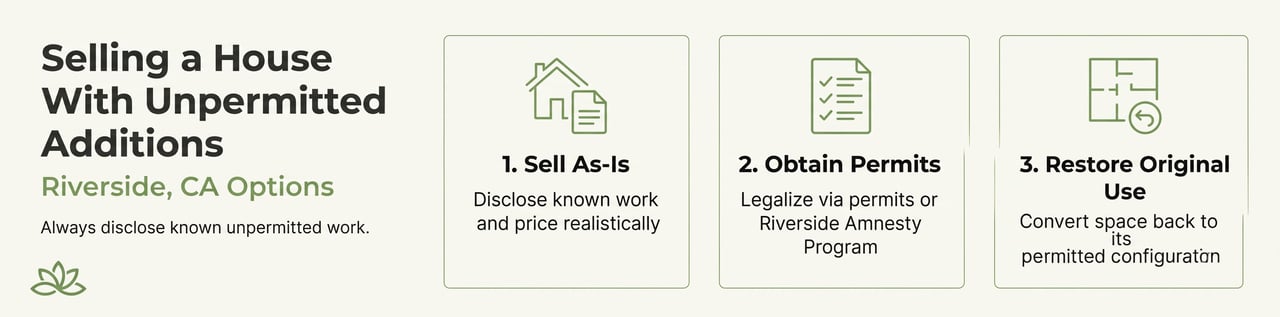
Every property is different. The right approach depends on the type of addition, its condition, the cost of obtaining permits, and your goals as a seller.
In many situations, homeowners choose to sell their property in its current condition with appropriate disclosures.
This may be a reasonable option if:
Buyers may request a lower purchase price or a seller credit to account for the uncertainty or potential expense of addressing the unpermitted work.
Before spending money on improvements, it's helpful to understand which repairs and updates matter most before listing your Riverside County home.
In some cases, obtaining permits after construction has been completed may be worthwhile, particularly when the addition represents a significant portion of the home's living space or value.
The process may involve:
Depending on the condition of the addition, this process can be relatively straightforward or become an expensive project.
Before committing to it, consider whether the potential increase in your home's market value justifies the expense and time involved.
Sometimes, restoring the property to its original permitted configuration is the most practical option.
For example, converting an unpermitted bedroom back into a functioning garage may improve the property's marketability, particularly in a neighborhood where buyers value garage parking and storage.
Any necessary demolition or restoration permits should also be considered.
This is why I recommend evaluating your options before starting construction. Our guide to what you should fix before selling your house can help you prioritize your spending.
The City of Riverside offers a Safety-First Amnesty Program that provides qualifying homeowners with opportunities to legalize certain unpermitted construction.
California Assembly Bill 2533 also provides protections for qualifying unpermitted accessory dwelling units (ADUs) and junior accessory dwelling units (JADUs) constructed before January 1, 2020.
Under this law, local agencies generally cannot deny permits for qualifying older units solely because they do not meet certain current building or zoning standards, although corrections may be required to address qualifying health and safety concerns.
For newer unpermitted ADUs, the city generally requires construction documents and compliance with currently applicable building codes.
These provisions do not automatically legalize every unpermitted addition, and owners may still incur inspection, construction, and other applicable costs.
Visit the city's Safety-First Amnesty Program or contact Riverside Building & Safety at (951) 826-5800 to discuss your property's eligibility.
An unpermitted addition can contribute value to a property, but it may not receive the same value as legally approved living space.
For example, suppose your Riverside home has 1,600 square feet of documented, permitted living space and a 400-square-foot unpermitted room addition.
Although the home physically contains approximately 2,000 square feet, you should not automatically expect it to sell for the same price as a comparable home with 2,000 square feet of fully permitted living space.
Several factors can influence its value:
A well-built enclosed patio may be viewed very differently from an unpermitted second-story addition with potential structural concerns.
An experienced Riverside real estate agent can prepare a comparative market analysis that considers these differences rather than relying solely on square footage or online home value estimates.
You can learn more about how we evaluate and market properties through Grove Realty's home selling services.
Yes, in some circumstances. An unpermitted addition does not automatically mean your home can only be sold to a cash buyer.
However, financing depends on the property, the condition of the addition, the lender's requirements, and the type of loan.
Fannie Mae's appraisal guidelines require appraisers who identify unpermitted additions to evaluate the workmanship, appearance, and potential effect on market value.
If the addition presents structural, electrical, plumbing, or other safety concerns, a lender may require further inspections or corrections before approving the loan.
Some buyers may also encounter challenges obtaining homeowners insurance, depending on the nature of the work and the insurance company's underwriting requirements.
It's important to identify these potential concerns early so that you can evaluate offers based on both the purchase price and the buyer's ability to close escrow.
Our step-by-step guide to selling a home in Riverside, CA explains how financing, inspections, disclosures, and escrow fit into the selling process.
Imagine a homeowner in Riverside's Magnolia Center neighborhood who enclosed a covered patio 25 years ago without obtaining permits.
The space is currently used as a family room and appears to be in good condition.
The homeowner may choose to sell as-is, disclose the unpermitted enclosure, and have the additional space marketed separately from the verified permitted living area.
Some buyers may appreciate the extra room even if it is not officially recognized as permitted living space.
A La Sierra homeowner converted a two-car garage into an additional bedroom and bathroom.
While the extra space may appeal to some buyers, others may prefer a functioning garage. The bathroom's plumbing and electrical work could also raise additional questions.
The seller should evaluate whether obtaining permits, restoring the garage, or selling in its current condition makes the most financial sense.
A Riverside homeowner has a detached guest house with a kitchen and bathroom that was built without permits before 2020.
Because of California's updated ADU legalization provisions, the owner may have an opportunity to obtain permits, depending on the property's circumstances.
Legalizing the unit could potentially improve marketability and increase its contribution to the home's value. However, the homeowner should first understand the applicable requirements and anticipated expenses.
The goal in each of these situations is not necessarily to achieve the highest possible selling price. It's to achieve the best financial outcome after considering expenses, time, and potential risks.
Our guide to how much you will net from selling your Riverside County home explains why your net proceeds are often more important than the final sale price alone.
A few common mistakes can make the selling process more complicated than necessary.
If there is an existing code enforcement notice, unresolved building violation, or significant safety concern, you should discuss it with the appropriate building department and, when necessary, a qualified real estate attorney before moving forward.
If you're searching for the best Realtor in Riverside, California, to help sell a home with unpermitted additions, look for someone who understands local housing, disclosure requirements, pricing strategies, and potential financing challenges.
Every home deserves an individual evaluation, especially when its permit history is complicated.
Marni Jimenez has been a licensed Realtor since 1990 and provides personalized service through Grove Realty, a boutique real estate brokerage serving Riverside and surrounding communities.
Whether you're downsizing, retiring, selling a longtime family home, or relocating, having a clear understanding of your options can help you avoid unnecessary expenses and make a more informed decision.
Before spending money on permits, repairs, or removing an addition, gather any existing property records and schedule a conversation with an experienced local Realtor.
At Grove Realty, I'd be happy to help you evaluate your home's potential market value, discuss your selling options, and determine what makes the most sense for your situation.
You may have more options than you realize.
You’ve got questions and we can’t wait to answer them.