What Happens When a Buyer Requests Repairs After a Home Inspection in Riverside, CA?
November 27, 2026
November 27, 2026
When a buyer requests repairs after a home inspection in Riverside, CA, the seller can typically agree to the repairs, offer a financial credit, negotiate an alternative, or decline the request altogether. California sellers are generally not obligated to agree to a buyer's repair requests, although existing contractual obligations and legal requirements still apply.
Receiving a lengthy inspection report can be overwhelming, especially when you thought negotiations were behind you. The good news is that a repair request doesn't necessarily mean your sale is in trouble. It's another opportunity to negotiate and find a solution that works for both parties.
Once a home goes into escrow, the buyer typically has an investigation contingency period to evaluate the property's condition. The standard California Residential Purchase Agreement generally provides 17 days for investigations unless a different timeline has been negotiated.
During this time, the buyer may arrange inspections of the home's roof, plumbing, electrical system, heating and air conditioning, foundation, and other components. They may also schedule separate termite, pool, sewer line, or roof inspections.
After reviewing the findings, the buyer may submit a formal Request for Repair using the California Association of Realtors' Request for Repair form, commonly referred to as the RR.
The buyer may request that the seller:
This is one of several negotiation stages involved in the home selling process in Riverside.
Generally, no. A home inspection report is not a mandatory list of repairs that the seller must complete.
Home inspectors are hired to document the property's condition. Their reports may include everything from minor maintenance recommendations to significant safety concerns. Even a well-maintained home can generate a lengthy inspection report.
However, there are important distinctions between a buyer's repair request and repairs or corrective actions required by an existing agreement, applicable law, or a buyer's lender as a condition of financing.
For example, certain FHA or VA financing requirements may need to be satisfied for the loan to proceed. California also has applicable requirements regarding smoke alarms, carbon monoxide alarms, and water heater strapping.
Understanding these differences can help sellers avoid agreeing to unnecessary expenses while keeping the transaction moving forward.
If you're preparing to sell, my guide on what to fix before selling your house can help you decide which improvements deserve your attention before your home hits the market.
Riverside has a wonderful mix of historic homes, established neighborhoods, ranch-style properties, and newer construction. The types of inspection findings often depend on the home's age, construction, and maintenance history.
Some issues that may come up include:
For example, an older home in the Wood Streets or Magnolia Center may warrant closer attention to its plumbing and electrical systems, while a newer home in Orangecrest or Citrus Heights may have maintenance concerns involving roof tiles, drainage, or HVAC equipment.
Riverside's hot summers also make the condition of the air conditioning system particularly important to many buyers.
The key is to distinguish between normal wear and tear, routine maintenance, and significant defects that could affect safety, financing, or the property's value.
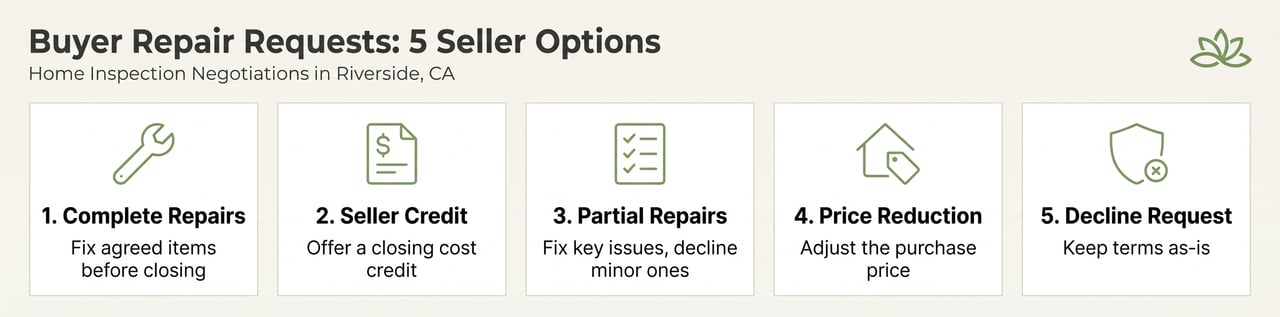
As a seller, you typically have five options when responding to a repair request.
You can agree to address some or all of the requested items before closing escrow.
This may make sense when repairs are relatively inexpensive, straightforward, or necessary to keep the transaction moving forward.
Any agreed-upon work should be completed according to the purchase agreement, with appropriate professionals, permits, and documentation when required.
Rather than coordinating contractors and completing repairs before closing, you may offer the buyer a financial credit.
This can be especially convenient for sellers who are relocating, downsizing, or managing a busy moving schedule.
The buyer can then arrange the work after taking ownership. However, the lender must approve any credit used in a financed purchase, and certain repairs may still need to be completed before closing.
You don't have to accept the entire repair request.
For example, you might agree to repair an active plumbing leak and address an electrical safety concern but decline requests for cosmetic improvements or minor maintenance items.
In some situations, adjusting the purchase price may be an appropriate alternative.
Keep in mind that a price reduction does not necessarily provide the buyer with additional cash to complete repairs after closing, particularly when financing is involved.
You may decide that the requests are unreasonable or that the home's condition was already reflected in the agreed-upon purchase price.
The buyer must then decide how to proceed based on the terms of the purchase agreement and any remaining contingencies.
When helping sellers negotiate repairs, I encourage them to look at the entire transaction rather than focusing solely on the amount the buyer is requesting.
Consider the agreed-upon purchase price, your anticipated proceeds, the strength of the buyer's offer, the time your home spent on the market, and the potential consequences of returning to the market.
Sometimes, offering a reasonable credit makes more financial sense than starting over with another buyer.
Other times, declining an excessive request is the better decision.
Our article on how much you will net from selling your Riverside County home explains how repair expenses, seller credits, and other transaction costs affect your final proceeds.
The following hypothetical examples illustrate how different situations might be handled.
A seller accepts a $750,000 offer on their Riverside home. Following the inspection, the buyer requests $8,000 to address several plumbing, electrical, roofing, and maintenance items.
After reviewing the inspection findings and obtaining estimates, the seller determines that $3,500 is a reasonable contribution toward the more significant concerns.
The seller offers a $3,500 closing cost credit instead of completing the repairs. The buyer accepts, the lender approves the credit, and the parties move forward with escrow.
A home in Riverside has an older air conditioning system that is still functioning properly. The inspector notes that the equipment is approaching the end of its expected useful life.
The buyer requests a new system.
An aging system is not necessarily a defective system. The seller may choose to decline the replacement request, arrange for an HVAC professional to evaluate the equipment, or negotiate a smaller credit.
An inspection reveals an active roof leak that the seller was previously unaware of.
Unlike a cosmetic concern, an active leak could cause additional damage and affect future negotiations if the current buyer cancels.
In this situation, obtaining an independent roofing estimate and negotiating a practical solution may be in everyone's best interest. The newly discovered condition must also be addressed through appropriate disclosures.
Yes, under certain circumstances.
If the buyer still has an active investigation contingency and has a good-faith objection to the property's condition, they may generally cancel the purchase agreement in accordance with its terms.
However, if the buyer has already removed the investigation contingency, their ability to cancel based on inspection findings becomes more limited. Other contractual contingencies or legal cancellation rights may still apply.
It's also important to understand that an investigation contingency does not automatically disappear simply because its deadline has passed.
If the buyer fails to remove the contingency within the agreed timeframe, the seller may have the option to issue a Notice to Buyer to Perform and subsequently cancel if the contractual requirements are met.
Your Realtor should carefully manage these deadlines and document any repair agreements, credits, and contingency removals in writing.
Yes. Selling a home as-is does not automatically prevent a buyer from conducting inspections or requesting repairs.
Unless the purchase agreement provides otherwise, the buyer may still have investigation rights and the opportunity to negotiate based on the findings.
An as-is sale also does not eliminate the seller's legal disclosure obligations. Known material defects must still be appropriately disclosed, including relevant issues discovered during escrow if the transaction does not close.
If you are considering selling without making significant improvements, understanding your options beforehand is important. My guide to buying and selling a home in Riverside provides additional guidance on property preparation, pricing, and negotiations.
After receiving a repair request, resist the temptation to respond emotionally. It can feel personal when someone presents a long list of concerns about a home you've loved and maintained for years.
Remember that the buyer is making a significant financial investment and wants to feel comfortable with their purchase.
Here are a few things I recommend:
If you're searching for the best Realtor in Riverside, California, look for someone with extensive local experience, strong negotiation skills, and the ability to guide you through situations like these without unnecessary stress.
I've been helping buyers and sellers navigate real estate transactions since 1990. Through Grove Realty, our boutique real estate brokerage, I provide personalized guidance because every home, seller, and transaction is different.
If you're planning to sell your Riverside home, have a conversation with an experienced Realtor about your property's condition before putting it on the market.
A thoughtful preparation and negotiation strategy can help reduce surprises, protect your proceeds, and make the selling process more manageable.
I'm Marni Jimenez, a Riverside Realtor, and I'd be happy to help you understand what repairs may be worth addressing, what you can leave alone, and what to expect during escrow.
At Grove Realty, our goal is to help you make informed decisions that are right for you and your next chapter.
You’ve got questions and we can’t wait to answer them.